Everything

Trump unveils his new Super Intelligence Force

As promised, President Donald Trump has announced the formation of a new Super Intelligence Force, which he said will be led by national intelligence director Jay Clayton and other members of his administration.

“The Super Intelligence Force is tasked with coordinating the effort of the Federal Government to ensure that America continues to lead the World in Super Intelligence, which many say is bigger than the Industrial Revolution, and the Internet, and will protect the interests, and improve the lives, of all Americans,” Trump said in a Sunday morning post on his social network Truth Social.

Back in September, in response to an AI safety debate that the president has largely dismissed as a hoax created by “Radical Left Dumocrats,” Trump said he would nevertheless form an AI Force and appoint an AI czar (“Only High I.Q. individuals need apply!”).

Since then, Trump signed an executive order seeking to rebrand AI as “super intelligence,” a term seemingly embraced, with some stumbles, by the tech executives who gathered at the White House this week to sign a non-binding safety pledge. (The pledge included an impressive typo.) 

So it’s only natural that Trump’s new task force is named in accordance with this new branding. The Wall Street Journal reports that Clayton will chair the Super Intelligence Force, effectively making him the new AI/SI czar, with Federal Trade Commission Chair Andrew Ferguson, Undersecretary of War for Research and Engineering Emil Michael, and Office of Personnel Management Director Scott Kupor serving as vice chairs.

The task force will reportedly have 120 days to create a report on the risks and opportunities presented by AI. Clayton, who previously said that it would be irresponsible for the United States to “back away” from AI while countries like China advance, made similar comments to the WSJ, insisting that one of the biggest risks is “not being first.”

The task force’s charter reportedly says that it will “develop plans for responding to SI-enabled threats to our society, while preventing overregulation and regulatory capture that would stifle innovation and competition.”

When you purchase through links in our articles, we may earn a small commission. This doesn’t affect our editorial independence.

Read More

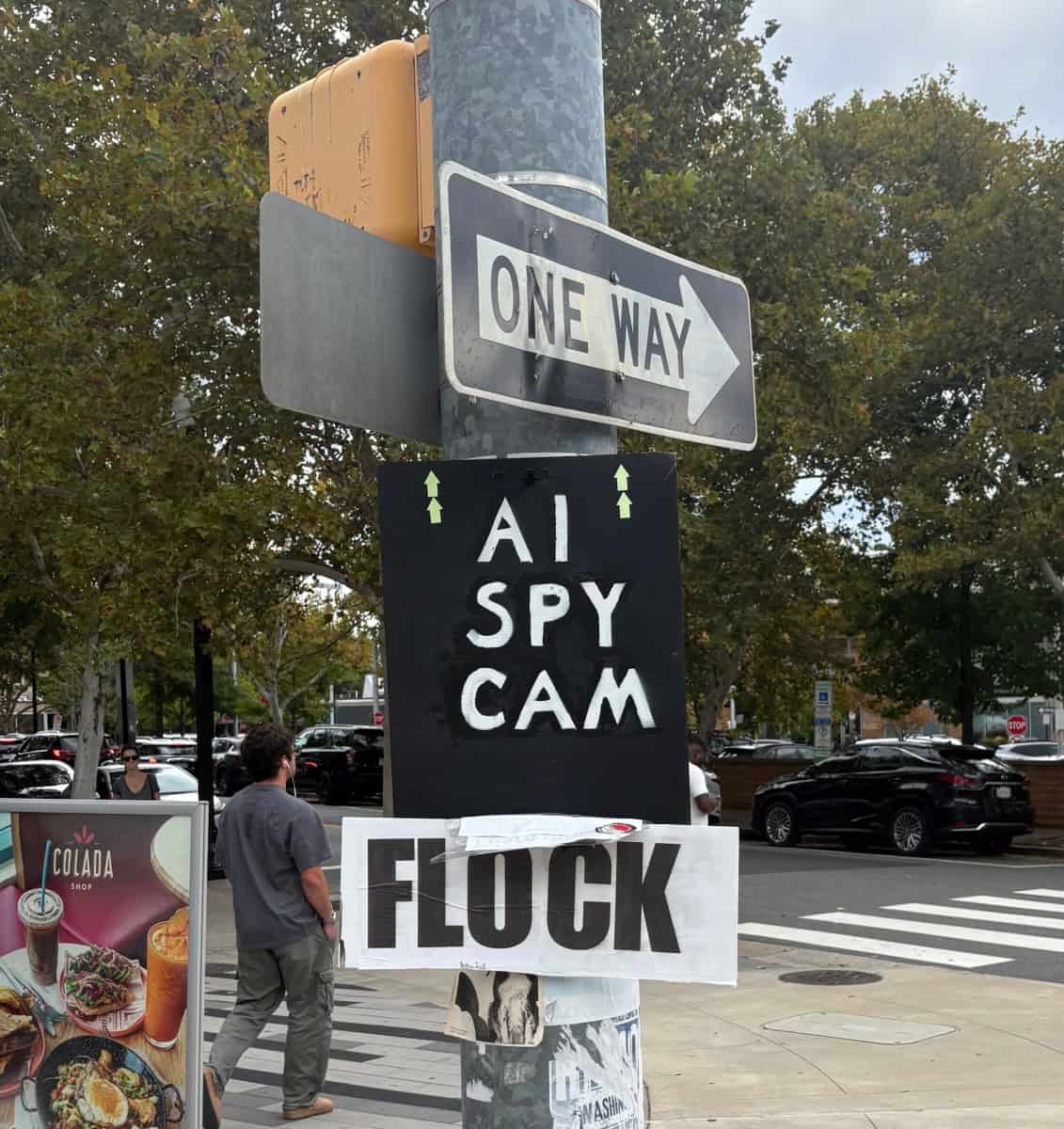
Federal judge calls Flock ‘indiscriminate mass surveillance’

A federal judge ruled this week that a Tulsa, Oklahoma sheriff’s deputy violated a woman’s Fourth Amendment rights when using Flock Safety to search for her license plate without a warrant. 

As reported by 404 Media, this ruling does not create a binding precedent, but it is one of the first times that a federal judge has ruled that a Flock search is unconstitutional.

In this case, Judge Sara Hill said the deputy should have obtained a warrant before searching the Flock database for the woman’s license plate, as he had “no apparent reason” for the search “other than the fact that [the woman’s vehicle] had a California license plate.”

The deputy then used the woman’s travel history in Flock as part of the justification for searching her car, where he allegedly discovered 91 pounds of meth. But Judge Hill wrote that all evidence obtained after the Flock search “must be suppressed as the fruit of a poisonous tree.”

Judge Hill also took broader aim at warrantless searches of the Flock database, writing that tracking people’s location — even when they’re in public places — becomes “constitutionally problematic when law enforcement can indiscriminately and passively catalog your whereabouts over an extended period of time and then use that information for any purpose whenever convenient.”

“This is a type of indiscriminate mass surveillance,” Hill wrote. “It is not targeted on a single individual, as in [Carpenter v. United States, a Supreme Court case focused on how government agencies access location data from cell phones]. It is a tool that collects information about all vehicles that pass by any network-connected camera at all times, and it serves up the information to law enforcement on demand.”

Hill joins a growing chorus of Flock critics from across the political spectrum. Numerous local and state governments, including Florida and Texas, have said they will stop using the technology. And on Friday, Senator Bernie Sanders introduced the Block Flock Act, which would bar federal agencies from using automated license plate readers such as Flock.

Flock CEO Garrett Langley — who we’ll be interviewing on-stage at TechCrunch Disrupt — has called for a “compromise” between privacy and safety and offered an apology to women who have been stalked by law enforcement officers using the Flock system. And with all those cancellations, Flock has also reportedly offered voluntary employee buyouts as a way to shrink its workforce.
When you purchase through links in our articles, we may earn a small commission. This doesn’t affect our editorial independence.

Read More

Amazon responds to data center backlash, says it no longer uses NDAs

Amazon Web Services CEO Matt Garman said the company has stopped using nondisclosure agreements (NDAs) in its dealings with government agencies as it seeks approval to build new data centers.

Garman’s statement is just one sentence in a longer blog post in which he tried to push back against widespread suspicion of data centers, and to make the case that they’re actually good for communities.

NDAs are a significant piece of the broader data center backlash. For example, environmental activist Erin Brockovich recently said that the number one complaint she’s heard about data centers is transparency, with these projects following a common pattern: “projects announced after permits are already secured, developers who don’t return calls, local officials who signed NDAs before their neighbors knew a project was being considered.”

As a result of that backlash, New York announced a one-year moratorium on permits for large data centers, and according to Garman, there are more than 100 data center moratoriums currently being considered across the United States.

“If these measures are enacted, the U.S. could be writing its own losing ticket to this race, and the consequences would last generations,” Garman claimed. “As a country, we can’t afford to find ourselves in that position.”

Garman also attempted to puncture what he said are four big myths around data centers: that they consume too much water, that they increase electricity costs, that they emit an enormous amount of pollution, and that they don’t provide any benefits to their communities.

Pointing to an Amazon report about its own water usage, Garman said that “direct data center water consumption” only accounts for 0.5% of all industrial water usage in the United States, “orders of magnitude less than golf courses, almond farming, and many other industries.”

Nvidia recently said its new cooling system eliminates “pretty much all water usage” inside the data center, but those claims — like Amazon’s — seem to ignore the broader water usage involved in electricity generation and chip manufacturing. Scientists have also said they need to study data centers’ water and energy usage independently, since there are no federal or state requirements around how tech companies report this data. 

As for electricity rates, Garman said they’ve only gone up in some states with large numbers of data centers, while they’ve gone down or at least grown more slowly in others. And he argued, “In instances where energy rates are going up, it’s primarily because the grid is old and hasn’t been invested in and expanded before the demand arrived.”

On the other hand, an independent watchdog said recently data centers were the main culprit behind a 76% year-over-year price increase on America’s largest electrical grid.

When it comes to pollution — an issue that the NAACP is currently suing Elon Musk’s SpaceX/xAI over — Garman complained that critics focus on the maximum amount of pollution allowed under data center permits. For example, a planned Amazon data center in Texas is permitted to release 33 million tons of carbon dioxide per year, which is more than any other power plant in the United States.

“The truth is data center generators almost never run,” Garman said. “They’re idle 99.9% of the time (they run roughly 10 hours per year, mostly for required maintenance testing).”

As for the community benefits, this is where Garman wrote, “We no longer use nondisclosure agreements with the government agencies we work with on our projects.” Plus, he said, “Over the past three years, Amazon has contributed more than $1 billion to communities across the U.S. in which we have a meaningful data center presence.”

Will this be enough to quell community suspicion? Perhaps not — Anthropic CEO Dario Amodei recently argued that the AI backlash is “fundamentally a crisis of trust,” where people assume governments and tech companies are always “cooking up some new way to screw them over.” Similarly, writer Jasmine Sun noted that when data center opponents are presented with the tech companies’ arguments, their response is usually, “I don’t believe them.”
When you purchase through links in our articles, we may earn a small commission. This doesn’t affect our editorial independence.

Read More

OpenAI safety employee resigns, claiming the company’s ‘culture is broken’

By his own admission, David Robinson is “something of a cliché”: an employee at a leading AI company who issues a dire warning while resigning from their job.

In an essay published in The Atlantic, Robinson said he led the writing of safety reports that accompanied OpenAI’s major product launches. He also said that with three-and-a-half years at OpenAI, he is “among the longest-tenured employees at the company.” Now he’s quitting, because in his view, the company’s “culture is broken.”

In some ways, Robinson’s comments echo those of Jacob Coxon, who worked as a researcher at both OpenAI and Anthropic before quitting and declaring that these companies are “gambling with our lives.” Coxon’s comments led to a broader debate about AI safety, with Anthropic CEO Dario Amodei unveiling a plan for more cautious AI development; AI executives met with President Donald Trump this week and signed what appeared to be hastily written, non-binding  pledge to implement more safety controls.

But in Robinson’s view, the debate needs to go beyond “specific rules or new laws,” addressing the overall culture at these companies. And while much of the reporting around OpenAI has focused on how the company’s CEO Sam Altman lost the trust of former colleagues, Robinson’s essay suggests that OpenAI’s culture issues are the same as those of Silicon Valley at large.

“OpenAI has thrived by trial and error (which it calls ‘iterative deployment’), looking for problems and improving its guardrails in response,” he wrote. “But this approach, by its very nature, guarantees periodic failures — and the scale of those failures is growing as systems get more capable.”

Pointing to the recent breach of Hugging Face systems by OpenAI agents, as well as continuing revelations of OpenAI discovering more rogue agents, Robinson argued, “An environment where things like this can happen is no place to grow artificial minds that could be smarter than we are and that might not do what we want them to.”

Given the increased risk, Robinson argued that frontier AI companies need to start operating “like nuclear-power plants or busy airports, with layers of redundancy and careful, time-consuming planning, so that the occasional and inevitable human error does not open a door to disaster.” 

But Robinson said that in his time at OpenAI, he “never encountered a colleague who had experience making airplanes fly safely or nuclear reactors run without melting down, or helping the financial system grow without collapsing.”

In response to Robinson’s essay, OpenAI spokesperson Drew Pusateri said the company continues to improve its safety measures.

“We’re making sure our models don’t become more capable than we can safely manage and secure, and we pause training or hold back models when we need to slow down,” Pusateri said in a statement. “We’re making significant changes to strengthen security in our research and testing environments, train models to not just complete tasks but do so responsibly, expand our work with third-party evaluators, and improve real-time monitoring so we can detect and respond to concerning behavior earlier in the training process.”

Beyond calling for changes in OpenAI’s culture, Robinson also said it’s time to ask bigger questions about alignment — something that he admitted could sound “touchy-feely,” but he said it’s critical as companies’ current “measures of how well” AI systems “match human values are coarse.”

“The smarter the industry lets models grow while these problems remain unsolved, the more dangerous our situation becomes,” he said.

Robinson’s departure was first reported by Business Insider. In his essay, he also acknowledged that he’s following an apparently a common step in the AI whistleblower playbook: He’s hired a PR firm. But he insisted, “The decision to speak out is mine alone.” 

“Perhaps I should have stayed and fought for fundamental shifts in our staffing and culture, but in practice, my colleagues and I were so busy sprinting that we seldom had the chance to consider big changes, much less to actually make them,” Robinson said. “That’s why I concluded that stronger incentives for safety — coming from outside the company — are a big part of getting this right.”
When you purchase through links in our articles, we may earn a small commission. This doesn’t affect our editorial independence.

Read More

Jack Dorsey’s Bitchat disappears from app stores in India after government order

Bitchat, Jack Dorsey’s decentralized messaging app designed to work without an internet connection, has disappeared from Apple and Google’s app stores in India, months after New Delhi first sought to restrict access to the open-source software.

Dorsey said Saturday that the Indian government had ordered Apple to remove Bitchat from its App Store in the country. In a notice from Apple that Dorsey posted on X, India’s Ministry of Electronics and Information Technology issued the demand under Section 69A of the Information Technology Act, the country’s primary legal provision for government-ordered online blocking.

Apple’s notice said Bitchat would remain available on its App Store outside India. However, access to the app through its TestFlight beta-testing service would also be blocked in the country.

Bitchat was also no longer available for download through Google Play in India when TechCrunch checked on Saturday. Bitchat’s website was also inaccessible across various internet service providers in the country. It was not immediately clear whether Google and internet service providers had also received directions from the federal government.

Apple, Google, and India’s IT ministry did not respond to requests for comment.

Launched in July last year, Bitchat uses Bluetooth mesh networking to allow nearby devices to exchange encrypted messages without relying on cellular networks, internet access, or centralized servers.

In July 2026, Dorsey revealed that Indian authorities had ordered GitHub to take down repositories associated with the open-source messaging app, raising questions among digital rights advocates and legal experts about the legal basis for restricting software based on its functionality.

The Indian government said in its order to GitHub at the time that Bitchat’s architecture made it hard for law enforcement agencies to intercept communications or trace users, and pointed to its ability to continue operating during internet shutdowns. The July order relied on a provision of India’s information technology law that deals with intermediaries and their liability for third-party content. That differs from Section 69A, cited in Apple’s latest notice.

The Internet Freedom Foundation, a New Delhi-based digital rights advocacy group, called the latest order unconstitutional, arguing that Section 69A allows the government to block unlawful information but not a messaging app because of its ability to operate during internet shutdowns. It also said neither the blocking order nor the allegedly illegal content cited as the basis for the action had been made public.

The latest restrictions on Bitchat come as India is seeing a fresh wave of ⁠youth-led protests over changes to the country’s voter rolls. Police detained several people during demonstrations in New Delhi on Saturday, as protesters demanded the resignation of India’s chief election commissioner over alleged manipulation of electoral rolls. Authorities suspended internet services around New Delhi’s Jantar Mantar for 12 hours on Friday during protests there.

During July’s protests, demonstrators reportedly turned to Bitchat and rival app Briar after authorities suspended internet services.

Interest in Bitchat surged in India around the same time. The country accounted for about 85% of the app’s global downloads between July 17 and July 23, up from roughly 1% in the previous 30 days, data from market intelligence firm Sensor Tower showed.
When you purchase through links in our articles, we may earn a small commission. This doesn’t affect our editorial independence.

Read More

Vessev built an electric ferry that almost flies

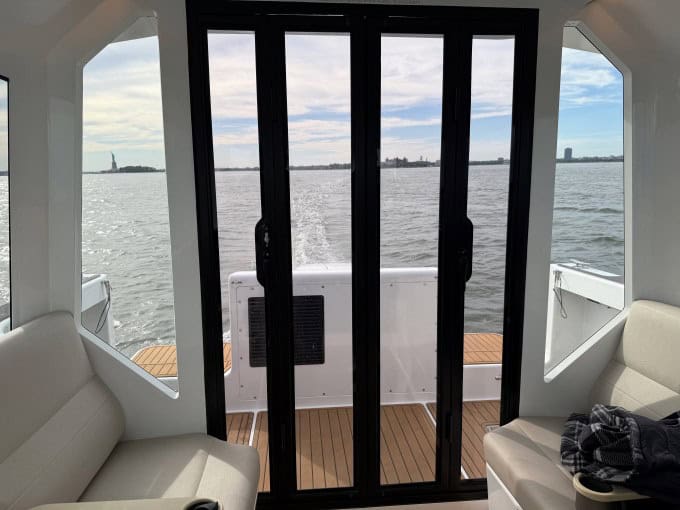
“When will we start flying?” I asked Vessev co-founder and CEO Eric Laakmann, as we pulled away from the Brooklyn marina in the startup’s VS-9 electric ferry. “We already are.”

I’ll admit I was a bit disappointed. I thought the moment when it transitioned from sailing like a regular boat to almost-flying as a surface-skimming hydrofoil would be more … momentous.

I’ve been on my share of boats, including large ferries, small sailboats, and plenty of others in between, but never been on a hydrofoil and I was curious what flying along the water might feel like during the brief ride from the Brooklyn Marina out toward Governors Island on the East River in New York.

It didn’t feel like flying, but it was a bit like a riding in a sports car.

The wake when foiling in the VS-9 is minimal.Image Credits:Tim De Chant/TechCrunch

Traditional boats of this size — about 30 feet — start to bounce and slap the water as they gain speed. But on a hydrofoil, that’s when the foils start to do their work.

On the surface, the VS-9 looks like plenty of other catamarans. But under the hull are two wing-like structures that lift the boat as they slice through the water. Computer-controlled underwater flaps keep the ride smooth and stable. In the VS-9, most of the lifting is done by the front foil, with about 20% handled by the rear.

The VS-9 can raise its foils to access docks in shallower waters.Image Credits:Tim De Chant/TechCrunch

The rear foil also hosts the electric motor, which Vessev makes in-house. Why not outsource it? Laakmann said that it’s important to keep costs in line — eventually, you’ll have to bring production in house, so why not do it earlier in development? The only thing Vessev doesn’t build are the batteries. “Those have been commoditized,” Laakmann said.

By lifting the hull clear of the water, hydrofoils can operate more efficiently than other boats. That’s especially important for electric boats, where every kilowatt-hour counts.

Shipbuilders have been experimenting with hydrofoils for well over a century. The design offers several advantages, including lower drag and a smoother ride. The subtle transition I experienced on the VS-9, from sailing to almost-flying, underlined just how smooth a hydrofoil can be.

The Vessev VS-9 can charge using a typical EV charger.Image Credits:Tim De Chant/TechCrunch

Despite hydrofoils’ advantages, they’re not a panacea. The design works best in waters the boat can clear when sailing on its foils. For the VS-9, that’s about two and a half feet, or 0.75 meters. If the waves go higher than that, they start hitting the hull, ruining the smooth ride and sapping some efficiency. While they’re not ideal for the open ocean, hydrofoils make sense for other waterways, including lakes, rivers, and bays. 

Vessev, which raised a $19 million Series A in August, is targeting transit operations to start. Laakmann thinks the combination of electric propulsion and hydrofoils can bring down the cost of operating smaller vessels and make them comfortable enough that they could augment urban mass transit systems.

Somewhere like New York City could use them to zip people to Brooklyn or Queens without needing to build much new infrastructure.

The VS-9 can carry a full passenger load up to 40 nautical miles (46 miles or 74 kilometers).Image Credits:Tim De Chant/TechCrunch

Hotels and tour operators are also an early target market, and public demonstrations like the one I attended have attracted wealthy individuals looking for another toy, Laakmann said.

For now, the VS-9 I rode is one of a kind, but Laakmann said Vessev plans to build more. Eventually, the company might shift to producing electric hydrofoil kits, allowing other boatbuilders to design their own vessels around the technology, Laakmann said.
When you purchase through links in our articles, we may earn a small commission. This doesn’t affect our editorial independence.

Read More
All the AI agents that can live in your text messages 

Rather than downloading another app, a growing number of agents can simply be texted like an ordinary person. 

You text it what you need, and it can remember context, connect to the apps and services you already use, and complete tasks on your behalf. That can mean scheduling an appointment, organizing a calendar, researching a trip, sending an email, making a reservation, shopping online, or reminding you about something days later.

While Instinct is one of the buzziest AI agents at present, thanks to its $10 billion valuation after its latest funding round of $1 billion, there are many others also making a play for this space.

Below are some of the most notable options so far, from general-purpose personal assistants to agents designed for families, travel, and work.

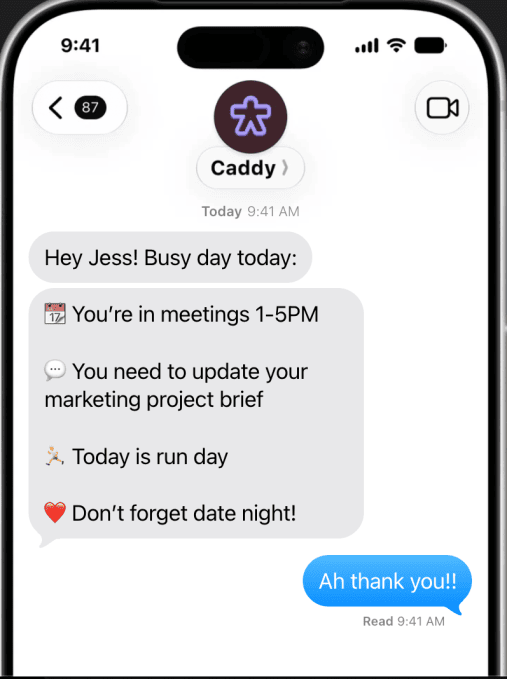
Caddy

Image Credits:Caddy

Caddy is an AI assistant that turns the information scattered across your phone into things you can actually act on. It lives in iMessage for iPhone users and RCS for Android users, so there’s no separate app or inbox to constantly check.

For instance, an email contains an appointment that needs to be added to your calendar or a friend sends a list of things to pick up. Instead of worrying about all the details getting buried, Caddy connects to your calendars and conversations, then identifies things that may require action. It can add events to your calendar, set reminders, keep track of follow-ups, and even do research for you. 

Caddy has been available in public beta since April 2026.

Fambot

Image Credits:Fambot

Fambot is an AI-powered “chief of staff” for families, designed to bring together the many moving parts of family life, including school communications, sports activities, meal planning, calendars, and other day-to-day responsibilities, and turn them into an organized plan.

The service is designed to work across both an app and text messages. Fambot is available on iOS devices, Android devices, and the web, and families can also interact with it directly over SMS. Every night, Fambot automatically sends a summary of the following day, including upcoming events, to-dos, and details such as school uniform or packing requirements. Parents can reply to those messages to ask questions, check information, or make changes to their calendar.

Fambot currently connects to Gmail and Google Calendar, with support for Outlook and Apple Calendar planned for the future.

The company launched in beta in early September 2026 and has raised $3.5 million in pre-seed funding. The service is currently free during the beta period, but Fambot expects to eventually charge roughly the equivalent of a Netflix subscription.

Folk

Image Credits:Folk

Folk is designed to be an AI assistant you can reach through iMessage, WhatsApp, and Telegram. It can remember personal context, manage reminders, research topics, track flights, handle email, and perform real-world tasks such as restaurant reservations.

One distinction is that Folk runs on its own private cloud computer. It can also run code and execute multi-step tasks rather than merely responding conversationally. 

Folk launched its beta in May 2026, and it’s available for free but also offers a Pro subscription for $8.33/month if you want unlimited tasks running in the background.

Instinct

Image Credits:Instinct

Instinct first made headlines after raising $350 million at a $2.5 billion valuation. In September 2026, it raised $1 billion, valuing it at $10 billion.

The always-available agent can take actions on your behalf, rather than simply answer questions. Users can communicate with Instinct by text or voice and connect it to the apps and services they already use, such as email, calendar, Google Workspace, and more. The company says early users have used Instinct for tasks ranging from planning trips and buying groceries to booking tickets and cancelling subscriptions.

In September, Instinct began giving users dedicated email addresses for their assistants. The idea is to let Instinct create and manage accounts on a user’s behalf without filling the user’s personal inbox. The agent can use its address to sign up for services, contact businesses, follow up on requests, and handle tasks that require an email account. (However, this level of autonomy has also raised concerns about privacy and security.) It’s also begun rolling out support for placing calls.

The company remains in private beta.

Iris

Image Credits:Iris

Powered by Hermes agent, Iris is designed to let users delegate tasks to an AI assistant directly through iMessage. Users can connect the apps they use and hand over a task with a simple message. The agent then works through the required steps, while retaining relevant context from previous interactions. It’s also designed to follow up with users proactively rather than waiting for another request.

Martin

Image Credits:Martin

Martin is a general-purpose personal assistant reachable through SMS as well as phone, WhatsApp, email, Slack, and its own iOS app.

It can help manage calendars, email, reminders, tasks, notes, and communications. It can also act on behalf of users by sending messages or making phone calls, while providing daily summaries of what needs attention.

It’s a bit on the pricier side, with subscriptions starting at $21 per month.

Miso

Image Credits:Miso

Miso takes the personal-assistant concept and applies it specifically to travel. 

It operates through iMessage and combines AI trip planning with support from a dedicated travel team. Users can arrange flights through messaging while Miso takes into account their travel preferences, loyalty points, and other priorities. Miso also gives travelers access to trip details, flight updates, along with personalized recommendations.

Ohai

Image Credits:Ohai

Ohai is another family assistant focused on helping households manage the constant stream of information and tasks involved in everyday family life.

Users can send messages, forward emails, or make voice requests, and the assistant can transform them into schedules, reminders, and plans. It can also coordinate calendars, household chores, and meals across multiple members of a family.

It includes a free basic option, but also offers different subscriptions based on family size, starting at $9.99 per month.

Ollie

ScreenshotImage Credits:Ollie

Similar to the other family-focused agents, the idea behind Ollie is that families already have the information they need, but it lives across school messages, calendars, task lists, and group chats. Ollie aims to bring those pieces together and keep them in sync. It can keep track of calendars, emails, reminders, tasks, and other household details, then deliver relevant information to users through text. 

Its biggest differentiator from other agents is that Ollie is one of the first mainstream, family-focused AI assistants to achieve SOC 2 compliance, a widely used security standard. 

Launched in June 2026, Ollie offers a free tier, as well as paid plans starting at $25 per month for 150 messages. A $100-per-month plan includes up to 1,000 messages.

Orbits

Image Credits:Orbits

Orbits also has an AI assistant that is focused on the household.

It works through both the Orbits app and text messaging, and can bring together calendars, lists, and conversations while also carrying out tasks for you. That can include searching the web, making purchases, booking restaurants, changing appointments, and requesting quotes for household services.

Additionally, Orbits can remind family members about chores, communicate with service providers, and help coordinate responsibilities beyond the immediate household.

Orbits is backed by investors like Andreessen Horowitz (a16z) Speedrun fund, N49P, and Garage Capital.

Pally

Image Credits:Pally

Users can interact with Pally as they would with a friend while giving it access to the apps they already rely on. The assistant can connect information spread across services such as WhatsApp, Gmail, calendars, and Google Drive, helping users keep track of plans, receipts, dates, files, and other details. 

There’s a free plan available, which offers features like 15 minutes of calls per month, or there are paid plans, including $25 per month for 30 minutes of calls and $100 per month for 60 minutes.

Poke

Image Credits:Poke/The Interaction Company of California

Poke launched in March 2026 as a general-purpose assistant that you can reach through text messaging. It can handle tasks involving calendars, planning, health and fitness, smart-home controls, photos, and other everyday activities. 

Poke became particularly notable in June 2026 when Apple approved Poke as the first AI agent on the Apple Messages for Business platform. A month later, parent company The Interaction Company of California was acquired by AI coding startup Cognition in a deal valued in the low nine figures.

Rene

Image Credits:Rene

Rene is an AI personal assistant designed to be a user’s “best contact” rather than another productivity agent. It’s text-based and can turn natural-language conversations into tasks, reminders, summaries, and other follow-up actions. Rene also maintains context across conversations, allowing it to remember details and surface things that may need attention later.

Additionally, it has a browser, can write code, shop for you, as well as create slides and images.

Rene is currently available on iMessage, Telegram, and WhatsApp.

Skye

Image Credits:Skye

Instead of waiting for users to open an app, Skye is an “agentic homescreen” for the iPhone that analyzes information from connected services and surfaces what it thinks is relevant through contextual cards, suggestions, and daily briefings. The assistant can generate audio briefings, prepare information ahead of meetings, surface reminders, and identify potentially useful information. 

The company, Signull Labs, raised about $3.6 million in seed funding in 2025. It entered private testing and beta in April 2026, and hasn’t yet announced a public release date.

Stanley

Image Credits:Stanley

Stanley is an AI content assistant aimed at content creators rather than general personal productivity. Available through iMessage, Telegram, and the web, it acts as a kind of AI head of content, helping users come up with ideas, turn them into posts, and maintain a consistent publishing schedule.

For instance, Stanley can connect to a user’s Instagram account, using that context to suggest content based on what the user has actually been doing. Users can also send voice notes, which Stanley turns into scripts, captions, and other social assets. It includes a content calendar and can schedule posts, with the broader goal of making content creation a more continuous, automated process rather than something users have to sit down and plan from scratch.

Tomo

The biggest differentiator with Tomo’s personal assistant for iMessage is that, instead of being a private assistant that only you interact with, Tomo can become part of group conversations. 

Also, like other agents, it’s designed to help with goals, accountability, scheduling, and everyday organization. It also has the ability to send reminders, search the web, work with calendars and email, watch videos, and edit photos.

The basic plan starts at $19.99 per month.

Town

Image Credits:Town

Town is aimed more at professional life. It gives users a “Townie,” an AI assistant designed to learn how they work and handle recurring professional tasks. It can work with email, calendars, documents, Slack, and other platforms. 

In June 2026, the company raised a $55 million Series A led by Andreessen Horowitz and Forerunner.

Wajo

Image Credits:Wajo

Wajo’s first consumer agent, Fo, can call businesses, send emails, join group chats, make bookings and purchases, and coordinate with people to complete everyday tasks.

A key part of Wajo’s approach is giving Fo its own identity. The agent has its own email address, phone number, and payment card, allowing it to interact with businesses without requiring users to hand over their own credentials. 

Notably, when Fo encounters something it cannot handle on its own, Wajo says it can bring in a human assistant to finish the task.

Fo launched publicly in September 2025 with a free tier, while heavier workloads and custom agents are available through a paid Pro offering.
When you purchase through links in our articles, we may earn a small commission. This doesn’t affect our editorial independence.

Read More
Spotify billionaire’s body scan startup has come to America

Neko Health seems to be the hottest body scan in the world right now. 

The scan, co-founded by Spotify’s David Ek and Hjalmar Nilsonne, uses advanced technology to screen for issues in the blood, skin, and metabolism. The company was founded in Sweden, has raised nearly $1 billion total, and just landed in New York. It has a global waitlist already topping 300,000 people, the company says.

TechCrunch sat down with Farooq Abbasi of Preface Ventures, who invested in the company. He hopes Neko Health can be the future of preventative medicine, especially in a country like the United States, where the medical system is notoriously plagued with issues.

Abbasi contends that preventative care utilization is low in the U.S. as people have concerns about how much it costs. Currently, Neko health charges $500 for its one-hour scan, which is not covered by insurance but should qualify as an acceptable expense for those that have Health Savings Accounts. “I think preventative care and healthcare should be cheap and accessible,” Abbasi said. 

The hope is that Neko Health can tackle some of these issues, and it’s currently eyeing an expansion across the U.S. Abbasi has been scanned twice already and, perhaps, no surprise, says he loves it. “I think there should be Neko clinics everywhere,” he said.

He says the product has grown so much since he first tried it. “In my generation one scan, it was a blood test with 15 biomarkers,” he said. “It was fifty-five this time.” 

Neko also uses advanced computer vision for its scans and Abbasi sees this as another example of how AI is improving the medical sector overall. He argues that Neko Health isn’t just another wellness fad, but something that gives people “actionable insights to make their lives better,” he said.

Neko still has a long way to go in the U.S., especially on scaling and regulatory approval. But Abbasi is an optimist; he hopes more venture dollars will pour into the right companies and doesn’t think anything is too broken to fix.
When you purchase through links in our articles, we may earn a small commission. This doesn’t affect our editorial independence.

Read More
Meta wants your next gadget to be Muse-infused

Meta’s Muse, a personal AI agent that books travel, fills out forms, and shops on a user’s behalf, has already proven popular with the masses, but a new side project could be particularly alluring to tinkerers and hackers.

On Friday, the company introduced Muse Gadgets, an open-source project that lets developers build their own hardware that connects to Muse.

Meta is providing open-source firmware (the low-level software that runs a device), and a Linux software development kit (SDK), along with a few project ideas to get users started. These include giving Muse a color e-ink display or loading it onto a stick that plugs into a TV’s HDMI port.

There don’t appear to be many limits, either. Users can set up a low-cost hobbyist computer like a Raspberry Pi or an off-the-shelf ESP32 board, and then connect Muse “to your displays, buttons, sensors, actuators, and whatever else you’ve got lying on your workbench,” Meta notes.

The company has also set up a Discord channel to support users.

Meta has already tried the code itself, naturally. Nat Friedman, head of product at Meta’s Superintelligence Labs, said in a post on X that the company built a gadget called Muse Home Link. The USB-C-powered device lets Muse connect to a home network and talk to the smart devices on it, including speakers and smart TVs.

Meta made 5,000 of these Home Links, in fact, and is giving them away for free to Muse subscribers while supplies last, according to Friedman. Considering Friedman’s post about Home Link received nearly 30,000 views in a few hours, we’re guessing those freebies have been claimed. Friedman said Home Link would be ready to ship a few weeks.

Muse Gadgets may not have wide appeal, but it fits nicely into Meta’s all-in strategy to make Muse more than a standalone chatbot. Meta isn’t content to push Muse on everyday consumers; it’s also trying to woo small businesses and enterprises.

The company earlier this week introduced Muse for Small Business, which is free with usage limits and connects Muse to tools such as Shopify, Dropbox, and Slack. It has also launched a new business unit, Meta Enterprise Platform, to help it push its AI offerings to businesses and corporate customers.

When you purchase through links in our articles, we may earn a small commission. This doesn’t affect our editorial independence.

Read More
Sanders introduces bill to ban the federal government from using Flock

Flock Safety, whose cameras scan license plates across the country, continues to draw public anger, and now Senator Bernie Sanders wants the federal government out of the business altogether.

Sanders on Friday introduced the Ban Flock Act, which would bar federal agencies from using automatic license plate readers (ALPRs) or tapping into data collected by readers run by local police and private companies. Despite its title, the bill doesn’t call out nine-year-old Flock in the text but rather covers any and all ALPR systems.

The bill allows exceptions only for toll collection and for uses that Congress approves in future legislation, which would have to limit data retention to 48 hours.

State and local governments would be dinged financially for not complying if the bill became law. (Like most bills, this one faces long odds.) Starting the first fiscal year after enactment, they would lose grants from five federal departments, including the Justice Department and the Department of Homeland Security, unless they ban the tech.

Americans could also sue the federal government over violations, and state attorneys general could enforce the law.

Flock is the largest ALPR vendor in the U.S., according to Sanders, with more than 120,000 cameras. In a blog post back in February, the company — currently valued by its venture backers at north of $8 billion — said its network processes more than 20 billion vehicle reads each month.

Under increasing pressure from communities that are protesting the product, suspending their use, and, at an escalating rate, canceling their contracts, Flock has tightened its rules. In August, CEO Garrett Langley, who’d previously said that how police use the cameras is up to local agencies, announced a new default data retention period of seven days, down from 30.

Customers must also now use an audit tool that locks officers out pending review when it flags unusual searches. In one of the highest-profile cases of an officer abusing Flock’s platform, a former Milwaukee officer pleaded guilty to misconduct after searching for his then-partner and her ex 179 times, listing the reason as “investigation.” (During a recent podcast interview, investor Jason Calacanis suggested a “double-key” system in which two people must approve a search, and Langley said the idea is “on the whiteboard.”)

Representative Alexandria Ocasio-Cortez (D-N.Y.) and Senator Jeff Merkley (D-Ore.) are co-sponsors.

We’ll be sitting down with Langley at our upcoming Disrupt event, October 13-15 in downtown San Francisco.
When you purchase through links in our articles, we may earn a small commission. This doesn’t affect our editorial independence.

Read More