Many firms are still falling behind when it comes to getting their AI infrastructure up to speed

Share this article

Join the conversation

Follow us

Add us as a preferred source on Google

Newsletter

Subscribe to our newsletter

Two in three IT leaders say their infrastructure isn’t ready to handle AI and analyticsComplex data regulations are giving them a major headacheAI PCs also form part of the broader infrastructure considerationsAccording to a new report by Dell, UK businesses are struggling more than their EMEA counterparts when it comes to AI, with three in five (61%) British firms lacking a clear roadmap covering AI, data and security, compared with 46% across EMEA.But one thing they have in common with their Europe and Middle East counterparts is that legacy infrastructure is likely one of the biggest factors slowing effective AI deployment.Nearly two-thirds (64%) of IT leaders say their infrastructure is not yet fully prepared to support AI and analytics workloads at scale, noting substantial gaps between ambitions and reality.Latest Videos FromTechRadarData foundations and IT infrastructure are still holding back AIHaving to coordinate compliance and regulatory factors across their entire stacks is also making it difficult for enterprises to lay out solid foundations, the report claims. More than half (55%) say security and compliance concerns have already slower or delayed their AI strategies, with 64% of leaders worried about regulation compliance when using their data for AI.And it’s not just complex IT infrastructure that’s holding back widespread deployment, because even end-user devices need to be considered. Nearly all (92%) respondents agreed that modern devices help them in terms of productivity, but four in five (79%) are being held back by outdated devices.

You may like

To that tune, 86% of EMEA leaders now agree that AI PCs will play an important role in their strategies going forward. As of the beginning of 2026, AI PCs accounted for around 44% of all PC shipments (per Omdia tracking), marking a healthy ongoing rise.”The focus is shifting from exploring what’s possible to connecting the infrastructure, data, security and workplace technology needed to turn AI into real business value at scale,” UK&I MD and Dell SVP Steve Young explained.Sign up to the TechRadar Pro newsletter to get all the top news, opinion, features and guidance your business needs to succeed!While IT leaders clearly understand some of the factors holding back effective AI deployments, at least two clear challenges are identified in Dell’s report – complex regulatory environments and an expensive PC market driven by component shortages.

Follow TechRadar on Google News and add us as a preferred source to get our expert news, reviews, and opinion in your feeds.

Read More

How to watch Where’s Wanda season 2 online – stream the German dark comedy from anywhere

Share this article

Join the conversation

Follow us

Add us as a preferred source on Google

Newsletter

Subscribe to our newsletter

After the first season literally answered the question ‘Where’s Wanda?’, you’d be forgiven for thinking the show might call it a wrap there. But, after finding Wanda standing over a dead body, there are now more questions than ever for Dedo and Carlotta to deal with.In season 2, Wanda is now at the center of a murder investigation, meaning her family must dive into the dark criminal underworld once more in order to prove her innocence. Sundersheim may look like a nice, quiet town on the surface, but there are sinister secrets lying beneath suburbia.

The good news is we’ll see lots more of Wanda (Lea Drinda). The bad news is her current predicament will put a lot of strain on the Klatt family. Can they stay strong for their daughter and rebuild, or will this latest catastrophe tear them apart?Read on as we explain how to watch Where’s Wanda season 2 from anywhere.
Can you watch Where’s Wanda season 2 for free?Yes. Apple TV offers new customers a 7-day FREE trial, which would let you watch at least some of Where’s Wanda season 2.Traveling abroad right now? You can use a VPN to access your usual streaming services from anywhere with a VPN.
Use a VPN to watch Where’s Wanda season 2 from anywhere
A VPN is a handy piece of software that can make your device appear as if it’s back in your home country and unlock your usual streaming services. The best VPN right now? We recommend NordVPN – it does everything and comes with up to 75% off.
How to watch Where’s Wanda season 2 in the US, UK, Canada, Australia and worldwide
Viewers everywhere can watch Where’s Wanda season 2 on Apple TV.New episodes come out on Wednesdays starting October 21.An Apple TV subscription costs $12.99/£9.99/CA$14.99/AU$15.99 per month after a 7-day FREE trial in the US, UK, Canada and Australia respectively.Away from home? You can access your subscriptions by downloading a VPN and pointing your location back to your home country.
Where’s Wanda season 2 – Need to KnowWhere’s Wanda season 2 trailer

Where’s Wanda? — Season 2 Official Trailer | Apple TV – YouTube

Watch On

When is the Where’s Wanda season 2 release date?Where’s Wanda season 2 premieres globally on Wednesday, October 21.
Where’s Wanda season 2 episode guide
Where’s Wanda season 2 comprises 8 episodes, which will come out one by one on a weekly basis:
Episode 1: A year later and the Klatts are thriving, until a shocking death changes everything – Wednesday, October 21Episode 2 – Wednesday, October 28Episode 3 – Wednesday, November 4Episode 4 – Wednesday, November 11Episode 5 – Wednesday, November 18Episode 6 – Wednesday, November 25Episode 7 – Wednesday, December 2Episode 8 – Wednesday, December 9
Where’s Wanda season 2 cast
Heike Makatsch as Carlotta KlattAxel Stein as Dedo KlattLea Drinda as Wanda KlattLeo Simon as Ole KlattNikeata Thompson as Detective Michelle RauchPalina Rojinski as Katarina VinsonKostja Ullmann as Jonas VinsonDevid Striesow as RüdigerJoachim Król as Harald HesselAnton Dreger as Lukas NovakFrederic Balonier as Alex VinsonSam Riley as Mr. KimballAlexandra Maria Lara as Mrs. KimballHarriet Herbig-Matten as Lucie VinsonGisa Flake as BrauerDavid SchütterSuzanne von BorsodySascha GeršakTorben Liebrecht
When is the Where’s Wanda season 2 season finale?The eighth and final episode of Where’s Wanda season 2 will premiere on Wednesday, December 9.

Disclaimer

VPN services are evaluated and tested by us in view of legal recreational use. For example: a) Access to services from other countries, (subject to the terms and conditions of that service). b) Safeguarding your online security and making your online privacy more robust when abroad. Future plc does not support nor condone the illegal or malicious use of VPN services. We do not endorse nor approve of consuming pirated content that is paid-for.

Read More

‘How do you know what’s real?’: US utilities are making AI data centers prove they exist before handing over power connections — as 50% of planned buildouts are currently being delayed, stalled, or canceled

Share this article

Join the conversation

Follow us

Add us as a preferred source on Google

Newsletter

Subscribe to our newsletter

US data center developers have requested 1,066GW of grid connections, but Wood Mackenzie expects utilities to commit to only about 28%Utilities are demanding collateral, longer contracts, and study fees; Exelon’s high-probability load fell from a whopping 18GW to 11GW once it insisted on the former Because grid costs are shared, phantom demand risks landing on household bills, and nobody knows how much of it is real yetUS utilities and grid operators are now demanding higher rates, longer contracts, collateral, and steep engineering study fees from data center developers, in an attempt to weed out what the industry calls “phantom” data centers.Reporting from The Wall Street Journal claims the reasoning is straightforward: Grid costs are shared, so if a utility builds substations and transmission lines for a project that never shows up, everyone else on the network ends up helping to pay for them.The numbers back up the nerves in play: developers have requested 1,066GW of grid connections for US data centers, according to a Wood Mackenzie analysis first reported by Bloomberg in August 2026, a figure equal to roughly 83% of the country’s entire utility-scale generating capacity at the end of 2025.Latest Videos FromTechRadarA queue full of ghosts as collateral becomes the norm?Wood Mackenzie expects utilities to commit to serving only about 28% of it: roughly 12% that already has firm service commitments, plus a further 17% that looks likely. The WSJ also cites a separate Wood Mackenzie measure that puts just 23% of disclosed requests in its high-confidence category.Much of the gap is due to duplication; developers who don’t yet know which utility can deliver power fastest file the same project with several of them and keep every option open until one pans out.

You may like

Others are simply speculators: commentary in POWER Magazine argued that private equity funds, land brokers and shell companies are claiming queue positions without site control or a signed customer, betting that land with a grid connection attached will find a buyer.The phenomenon isn’t new. Utility Dive was writing about phantom data centers in 2025, and TR reported in July that 67% of electricity executives surveyed by Capgemini were seeing speculative applications for capacity. The change is that utilities are now pricing the problem, and it is causing many adverse effects.Sign up to the TechRadar Pro newsletter to get all the top news, opinion, features and guidance your business needs to succeed!Exelon’s attempts to lock down potential consumersExelon, which runs utilities across the Mid-Atlantic and Midwest, offers the clearest look at what happens when developers are asked to put money down.After it began requiring transmission security agreements (TSAs), contracts that bind customers to credit obligations, committed revenue contributions, and shortfall payments, its high-probability data center load fell nearly 40%, from 18GW at the end of 2025 to about 11GW in the second quarter. Its wider pipeline of projects under study dropped from about 43GW to 25GW.Jeanne Jones, Exelon’s CFO, told the WSJ that typical requests used to be around 50MW and now often run to 1,000MW or more. The question she kept fielding, internally and externally, was “How do you know what’s real?”

What to read next

Exelon, however, also told analysts its $41 billion capital plan through 2029 is unchanged, so a 40% cut in expected data center load has not, so far, shrunk the spending plan.None of this would matter much if grid capacity were cheap, but it simply isn’t. PJM, the largest US grid operator, saw its capacity auction clear at the price cap for the third time in a row this summer while missing its reliability target by 6.8GW.In September, its independent market monitor told federal regulators that 4,017MW of forecast data center load, 42% of the growth PJM had assumed, had already been canceled or delayed.Households are feeling the cost increase; reports in July indicated that Henrico County, Virginia, asked staff and schools to cut electricity use after a 24.9% rate increase. Virginia has also moved to stop utilities passing data center costs onto everyday users, and Texas bills are rising faster than inflation. Lindsey Short of the Ohio Manufacturers’ Association warned against building the grid around “the most optimistic number on somebody’s spreadsheet.”Underbuilding carries its own risks, though, especially when transformers can take years to arrive, as a recent deep dive on grid bottlenecks laid out. That is why utilities are locking in the customers they do accept. Average minimum contract lengths for large customers have risen to about 10.8 years from 4.6 before 2024, according to filings aggregated by Halcyon and cited by the Journal, and a separate research brief built on Halcyon’s tracker found a similar jump.What nobody can yet say is how much of the AI power rush is real, and that poses problems for planners, stakeholders, and households alike. Until it does, utilities are doing what any lender would: asking to see the money first; households just happen to be roadkill if things don’t pan out.

Follow TechRadar on Google News and add us as a preferred source to get our expert news, reviews, and opinion in your feeds.

Read More

Trump officials asked CISA to secretly hack a voting machine — and not disclose any vulnerabilities they found

Share this article

Join the conversation

Follow us

Add us as a preferred source on Google

Newsletter

Subscribe to our newsletter

Trump administration officials asked CISA to hack a voting machine just months into his second termCISA was told not to disclose any vulnerabilities to the voting machine manufacturerCISA has been gutted by job cuts and a lack of funding, with many state officials hesitant to trust the agency with securing the midterm electionsTowards the start of President Trump’s second term, allies in the Department of Homeland Security tasked the Cybersecurity and Infrastructure Security Agency (CISA) with secretly acquiring a voting machine with instructions to hack it and not tell anyone except the White House about the vulnerabilities they found.ProPublica, who spoke to two former administration officials with knowledge of the request, noted that the standard practices of CISA require the agency to let manufacturers know of vulnerabilities in their technology, but the political appointees explicitly asked CISA not to.“My thought was they could keep it in their back pocket to invalidate any [election] results they don’t like,” one of the former officials told ProPublica. “This goes against everything CISA represents.”Latest Videos FromTechRadarCISA asked to hack voting machineCISA has been a relentless target of the Trump Administration, with the agency’s jobs being cut by one third and the majority of its senior leadership resigning or being fired.In total, CISA has cut 1,000 jobs since the start of Trump’s second term – largely down to Elon Musk’s Department of Government Efficiency – with additional cuts to funding in 2027 likely to result in a further 900 jobs being lost.

You may like

As a result of these job cuts, remaining CISA employees told the political appointees that the request to hack a voting machine couldn’t be fulfilled.Since 2018, CISA has been responsible for helping to protect election infrastructure from cyber attacks and interference, but has had to cut back on much of its work in these areas due to a lack of funding and staff. Many state officials have been unable to seek election support ahead of the November midterm elections.Sign up to the TechRadar Pro newsletter to get all the top news, opinion, features and guidance your business needs to succeed!As a result of Trump’s cuts to CISA’s jobs and funding, many state officials fear the agency has become a shell occupied by Trump loyalists. “They’ve violated the entire premise of that information-sharing relationship,” a former high-ranking federal cybersecurity official told ProPublica. “There’s no fucking way they’re ever going to give any information to CISA. And it’s unclear if they ever will in the future.”In response to the claims, White House spokeswoman Lauren Bis said, “President Trump has done more than any other President to ensure we have free and fair elections.”“I don’t pay attention to what the president says. I pay attention to what his administration does,” said Arizona Secretary of State Adrian Fontes. “And what they’ve done is basically cut us off and left us on our own.”

What to read next

Voting difficulties start earlyEarly voting for the midterms has already started in some states, but early polling sites at North Carolina Agricultural and Technical State University, the University of North Carolina Greensboro, and Western Carolina University have been shut down, with Guilford County board members saying the resources could be better allocated elsewhere.Shutting the polling sites makes it significantly harder for the collective 40,000 students to vote, with university policy preventing some students from owning a car during their first year of study.Shia Rozier, a senior at North Carolina A&T and cofounder of student organization Protect Ours NC told NPR, “In order to get to the polls, they now have to get a Lyft or get a Uber or get somebody to take them at a time where gas prices are extremely high, creating an additional barrier to the poll.”In response, students organized a march to the nearest polling site over 45 minutes away.

Follow TechRadar on Google News and add us as a preferred source to get our expert news, reviews, and opinion in your feeds.

Read More

Instinct brings its AI agent to group chats, even for friends without an account

Instinct, the AI agent now valued at $10 billion as of its latest funding round, is expanding into group chats. The startup announced on Monday that users will be able to add the agent to chats with friends, which could be helpful in certain scenarios like travel planning, snagging event tickets, running fantasy leagues, organizing carpools, or managing who’s bringing what to Thanksgiving.

Notably, the group chats with the AI agent will work even if a user’s friends haven’t joined Instinct, the company said.

With the launch, Instinct moves ahead in its battle with top competitors in the space, like Meta’s Muse. The latter doesn’t yet offer the group chat functionality, though Meta’s older app, Meta AI, can be added to group chats on WhatsApp, Messenger, Instagram, and Facebook.

Instinct in group chatsStarting today, early access users can add Instinct to group chats. A new Instinct joins and works for the whole group.Making plans with friends usually turns into a frustrating back-and-forth over times and places. With Instinct in the group, you can… pic.twitter.com/pqJX7ieC7B— Noah Shinn (@noahrshinn) October 5, 2026

Instinct and Muse have been running neck and neck recently, with both of them adding the ability to make phone calls over the past couple of weeks, as their agents try to win more of the consumer AI market. Last week, OpenAI launched ChatGPT Dots, personal AI agents that can also be used in ChatGPT Spaces, collaborative workspaces where the Dots and humans work together.

On X, Instinct founder Noah Shinn explained how Instinct handles users’ privacy and security in group chats. He said a user’s personal Instinct agent will ask permission before connecting with the group’s Instinct agent, and that users can also choose which groups they trust and can remove that trust at any time.

Shinn also said the group’s Instinct is siloed from the users’ personal accounts, which it cannot access. The personal agent will always ask the user’s permission before sharing information or taking any action.

If new members join the group chat, any pending replies from a user’s personal Instinct agent are held before those are shared with the group, too.

“Making plans with friends usually turns into a frustrating back-and-forth over times and places. With Instinct in the group, you can explore options together, agree on a plan and get it done, all in one thread,” Shinn wrote.

The feature is rolling out initially to Instinct’s early access users but will expand to all users “soon.” To gain access to the new feature (or other recent additions), users can ask their Instinct agent to put them on the list to try it out.

When you purchase through links in our articles, we may earn a small commission. This doesn’t affect our editorial independence.

Read More

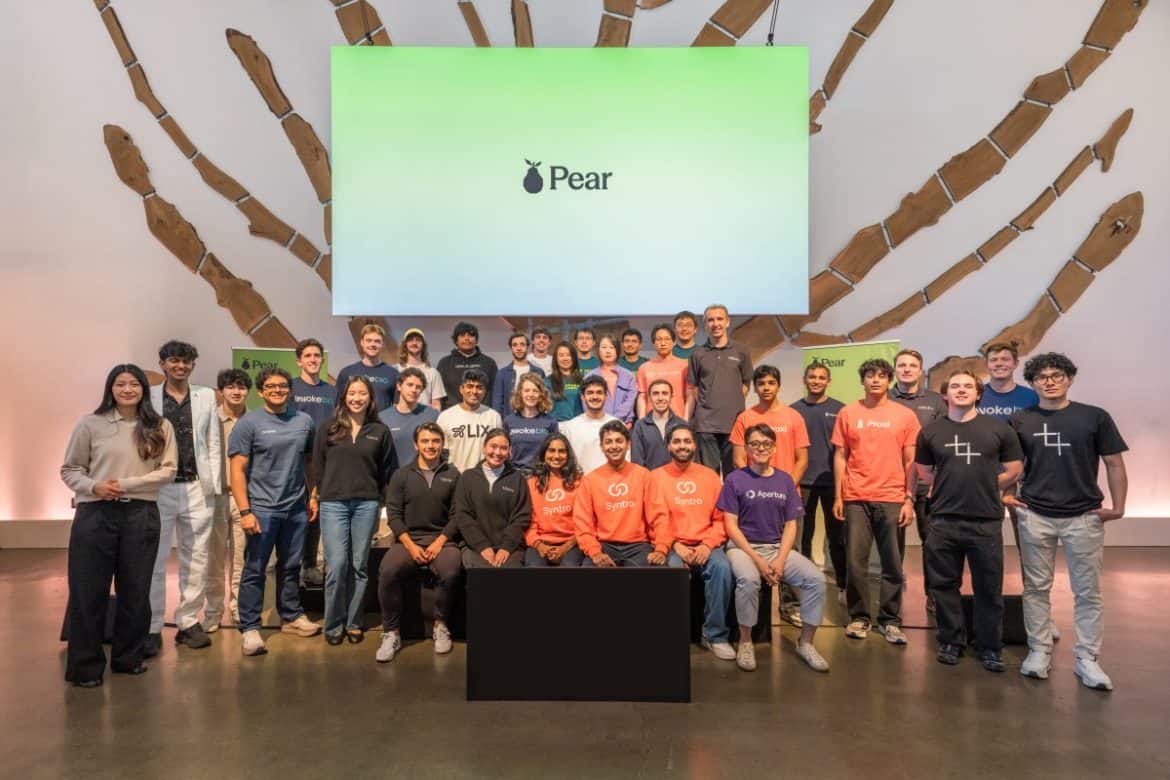
5 startups that caught VCs’ attention at the latest PearX demo day

There isn’t a shortage of accelerators for startups, but one of the few that investors watch closely is PearX, a 12-week program that caps its cohorts at a mere 20 startups and is run by Pear VC, a pre-seed and seed-focused venture firm.

PearX’s biannual demo day is consistently attended by top venture capitalists, reflecting the historically strong caliber of companies in each batch. Some of the startups that came out of recent cohorts include Known, which uses voice AI to match people for dates and secured funding from Forerunner Ventures. Another is Andera, a startup that automates corporate audit and compliance tasks and raised a $37 million Series A from Lightspeed this summer.

The PearX program distinguishes itself from Y Combinator, the OG of startup accelerators, in several ways. Besides being much smaller, it doesn’t offer companies standard terms. Its investments can be as high as $2 million. Moreover, unlike YC, where some of the buzziest startups raise funding before the program ends, PearX claims to keep its participants under wraps until demo day.

TechCrunch attended Pear’s latest demo day, which took place in San Francisco last week, and then stuck around to ask some of the VCs about which companies stood out to them out of the 16 startups in the batch.

Below are five of the companies that seemed to have generated the most buzz.

Speridlabs

What it does: Spatial foundational models for powering robotics, gaming, and special effects.

Why it stood out: While Speridlabs is certainly not the only startup developing world models to do for 3D space what LLMs did for language, it argues that its more established competitors, including Runway, Odyssey, and Google’s Genie, cannot be queried or modified. To solve this, Speridlabs built Mundus, which it calls a 3D Midjourney because it keeps its geometry persistent when a part is changed.

Saia

What it does: Builds a fast, cost-efficient chip that runs inference directly on device.

Why it stood out: Nvidia’s GPUs and Google’s TPUs require expensive, power-hungry memory that is currently in short supply. Saia claims to have designed a chip that bypasses traditional memory by running AI directly out of flash storage. The startup claims its chip delivers vastly superior speeds and eight times the capacity while using four times less power than Nvidia’s Jetson, a leading local AI chip and board. Saia says it’s already in discussions with Samsung regarding memory integration, plans to start fabricating test chips next year, and aims to launch mass production by 2028. Developing hardware is notoriously brutal, but 20-year-old founder Ayaan Govil managed to convince Pear VC co-founder Mar Hershenson, a semiconductor engineer with a PhD in circuit design, to take a chance on his vision.

Ren

What it does: A more secure AI personal assistant.

Why it stood out:  Ren claims to offer functionality similar to Muse and Instinct, but with a heavy focus on security and privacy. The startup says it keeps data on-device where possible or uses a secure private cloud, checking actions against strict user-set guardrails. Furthermore, Ren distinguishes itself from competitors that rely on human operators to place phone calls by using a fully automated voice system, keeping human involvement entirely out of the loop to protect user privacy.

Veros

What it does:  AI native trust and estate planner.

Why it stood out: Setting up a trust is expensive and time-consuming. Veros wants to simplify the work normally done by attorneys, wealth managers, and trust administrators by employing AI to recommend structures and manage assets over their lifetime. Already managing $250 million in AUM, the startup is also in the process of securing a trust charter so it can operate as a regulated trust company itself.

Datum

What it does: AI engineer for industrial design.

Why it stood out: Datum wants to expedite physical product development by helping engineers find and use what they built previously. The startup indexes a company’s library of 3D designs. Using proprietary Geometric Fingerprint technology, Datum identifies parts based on their shape, helping streamline and automate engineering across a massive physical design market.

When you purchase through links in our articles, we may earn a small commission. This doesn’t affect our editorial independence.

Read More

HackerRank’s AI interviewer offers a glimpse into what job interviews could become

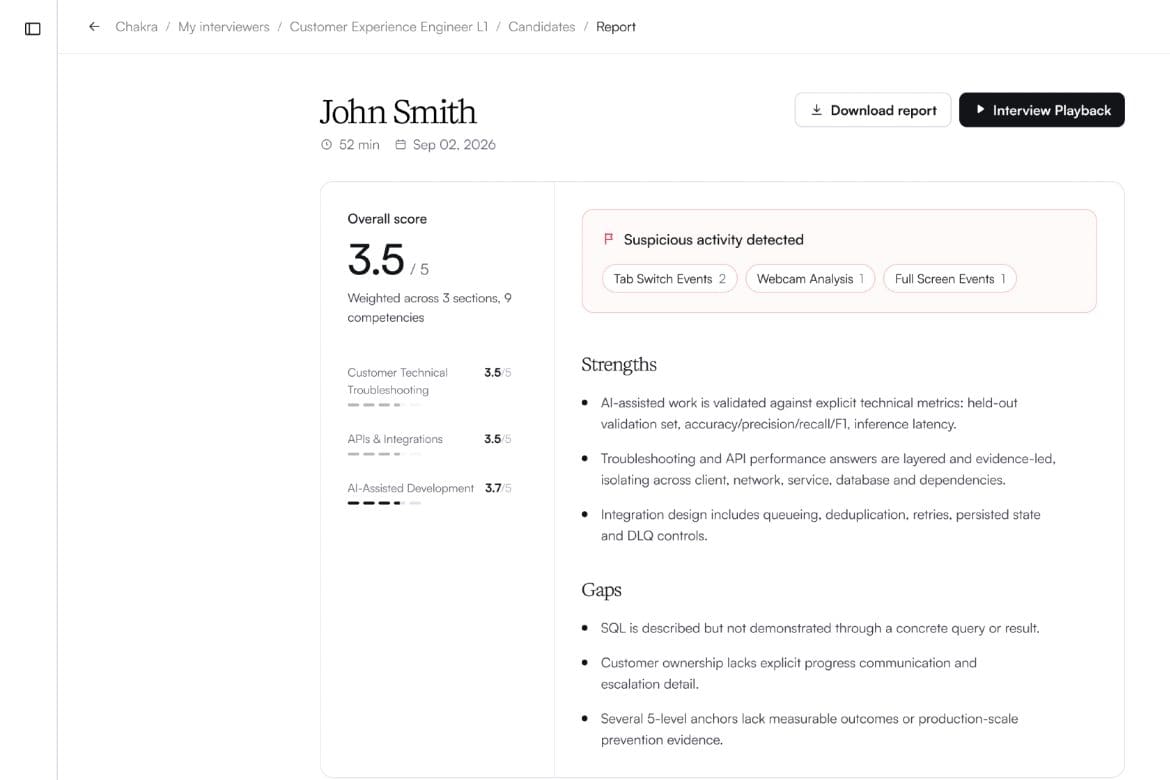
What happens when AI moves from helping job candidates to evaluating them? HackerRank, a platform used by companies to assess and hire developers, is offering a glimpse at what that future of job interviews could look like with Chakra, an AI agent that conducts interviews, observes candidates as they work, and evaluates not just their answers but also how they got there.

After around six months in beta, HackerRank is making Chakra generally available to its customers on Monday. The startup says the AI interviewer has already conducted more than 500,000 interviews during testing, with companies including Snowflake, Snorkel, and Capgemini among those that tried it, while HackerRank also tested the product internally.

AI has been a staple in job interviews for some time, with companies using voice agents and other automated tools to screen candidates and make the hiring process more efficient. Job seekers, meanwhile, have increasingly gained their own AI tools to help them navigate interviews, sometimes without employers knowing.

With Chakra, HackerRank is betting AI can change not only how interviews are conducted, but also what employers can measure. Beyond whether someone arrives at the right answer, the startup wants to assess harder-to-capture signals such as critical thinking and judgment, as well as what it calls “AI fluency” — how well a candidate frames a problem for AI, judges its output, and steers it toward a solution.

“The previous modality of evaluation was evaluating the output,” HackerRank co-founder and CEO Vivek Ravisankar said in an interview. “Now, because of AI, anybody can produce an artifact.” The question for employers, he said, becomes whether they can understand the thinking and judgment that went into producing it.

In practice, a Chakra interview is designed to look more like doing the job than taking a traditional coding test. A candidate gets a task involving a real-world code repository, and they work through it in a canvas that includes an AI assistant. As the candidate works, Chakra can use the context of what they are doing to ask follow-up questions, such as why they chose one approach over another, or how their solution would change if a new constraint were introduced.

HackerRank’s Chakra shows a detailed report to the hiring manager after the interview.Image Credits:HackerRank

Ravisankar told TechCrunch that Chakra is changing the basic structure of the hiring process itself. What previously involved three separate rounds, comprising a recruiter screen, take-home assessment, and follow-up interview with an engineer, is now combined into a single Chakra interview, he said.

Giving candidates access to AI during an interview might seem to make it easier to cheat. However, HackerRank says it found the opposite. Suspicious-activity flags, Ravisankar said, were 70% to 80% lower in Chakra interviews than in comparable traditional HackerRank assessments, though the rate varied depending on factors such as geography and seniority.

Ravisankar told TechCrunch that giving candidates access to AI reduces the incentive to secretly use outside tools that can feed them answers during an interview.

Launched at TechCrunch Disrupt in 2012, HackerRank built its business around coding challenges, eventually helping companies assess and hire developers based on their technical skills. The Y Combinator-backed startup now has more than 3,000 business customers, including Amazon, Nvidia, Clay, and Replit, and a community of over 30 million developers worldwide.

Chakra represents a bet against the kind of technical assessment business HackerRank spent years building. Its traditional product largely tested whether developers could solve coding problems correctly. Nonetheless, Ravisankar believes AI has made HackerRank’s earlier model less useful to measure engineering ability.

Ravisankar compared the transition internally to Apple moving from the iPod to the iPhone, as the old product still has value, but the new one represents where the startup believes the market is headed. “Chakra is going to be the headline,” he said. “It’s going to be the way that we’re going to move forward.”

However, giving AI a deeper role in evaluating candidates raises a different set of questions, particularly around how much of a hiring decision companies should delegate to an algorithm. Ravisankar told TechCrunch that Chakra is designed to score candidates rather than make the final hiring decision, which remains with humans.

AI, he said, can handle more structured parts of an interview by consistently applying criteria set by an employer, while human interviewers can spend more time determining whether they actually want to work with a candidate and answering questions about the company, team, and role.

“AI is way less biased than humans, if you tune it properly,” Ravisankar said, arguing that an AI system can be instructed to follow the same rubric for every candidate rather than being influenced by factors such as a candidate’s background or education.

Applying the same criteria consistently, however, does not necessarily make an AI system free of bias. Automated hiring tools can inherit or amplify biases from the data, models, and criteria used to build them, prompting regulators to scrutinize their use in employment decisions.

The use of AI in hiring is already drawing regulatory scrutiny. New York City, for instance, requires employers using certain automated employment decision tools to subject them to an independent bias audit and provide notice to candidates before using them. Ravisankar acknowledged that hiring is a regulated area and said complying with such requirements is part of what HackerRank has had to build for.
When you purchase through links in our articles, we may earn a small commission. This doesn’t affect our editorial independence.

Read More

Hackers steal 8 million citizens’ records from Danish government database

The Danish government has confirmed that its central database of citizens’ data was breached and most of its contents were stolen. The data breach affects some 8 million citizens and residents of Denmark, including people living abroad and the deceased.

In a statement, Danish minister Christina Egelund said the breach of the country’s Central Person Register (CPR) was a “serious incident,” which allowed hackers to steal names, addresses, Danish social security numbers, and other information.

The CPR is a government database of Danish citizens’ information, including their government-issued identity number for paying taxes and accessing other services. Denmark’s current population is about 6 million people, but the database includes records for about 11 million people, with some of the data going back decades. 

The Danish government would not say who is behind the breach, which happened in September but was discovered on October 2. However, it said the unauthorized access was obtained by “abusing a Danish company’s lawful access to search for information in the CPR system.” (Some companies in Denmark have access to the CPR for verifying people’s information with the government.)

The data breach is thought to be the biggest in the country’s history. It follows similar cyberattacks targeting government national identity databases, including a 2016 breach affecting millions of Turkish citizens and several exposures of national ID cards and data spilled from India’s national Aadhaar database of citizens.

Read More

Researchers are tracking a Chinese AI ‘agent fleet’

A new fleet of AI agents is making its presence felt on the internet. On Sunday, a group of independent researchers posted preliminary findings about the agents, observing that they seem to be running on Tencent’s infrastructure and targeting Alibaba’s map service, Amap.

Researchers, however, resisted the term “swarm,” noting that there seems to be little coordination between their different queries. “‘Agent fleet,’ not ‘swarm:’” one researcher wrote in the preliminary report, “many parallel agents on the same kind of task, with no sign of communication between them.”

The agents were discovered by monitoring traffic to the domain-scanning service urlquery, a technique that previously revealed long-running activity by OpenAI agents. AI agents often use urlquery to load websites that they cannot access directly, leaving a record of their activities that can be valuable to researchers.

In this case, the record showed queries to Alibaba’s Amap service, seeking directions to different entrances of various public places, including a park, a zoo, and a hospital.

The research is ongoing and so few details are available, but the behavior shows how persistent AI agent activity has become on the internet. In the wake of the Hugging Face incident, many researchers are actively monitoring for rogue agent activity on the internet. Much of that activity has been easy to find because agents tend to use the same techniques and make little effort to conceal themselves.

In this case, the agents don’t seem to have been doing anything more nefarious than side-stepping Alibaba’s API rules — but we may not always be so lucky.

Read More

The final Disrupt Stage lineup: Three days of conversations you won’t hear anywhere outside of TechCrunch Disrupt 2026

The biggest stage at TechCrunch Disrupt is where the people building the future come to talk about what happens next in the tech ecosystem.

Across three days, from October 13 to 15, at Moscone West in San Francisco, the Disrupt Stage will bring together some of the biggest game-changing founders, CEOs, and investors shaping everything from AI and robotics to transportation, social media, biotech, and venture capital, alongside the next generation of founders competing live in Startup Battlefield 200.

Don’t miss a single moment of these conversations shaping the future of the tech ecosystem. Get a front-row seat by registering for your pass here. Bring your co-founder, partner, colleague, or peer and save 50% on their second pass. Have more people who should be there? Save even more with bundle passes.

Image Credits:TechCrunch

Meet the entire Disrupt Stage lineup

Rivian CEO RJ Scaringe will unpack what it takes to build the seemingly impossible: turning an ambitious idea into a company capable of designing, manufacturing, and scaling complex physical products.

Cerebras CEO Andrew Feldman will tackle one of the biggest questions hanging over the AI boom: Can AI keep scaling? As models demand ever more compute, energy, and capital, Feldman will explore where the current trajectory leads and what could break it.

Science Corporation founder Max Hodak looks beyond screens at a future in which technology increasingly interacts directly with the human body, while Flock Safety CEO Garrett Langley joins us for a candid conversation about AI, surveillance, and the future of public safety.

Image Credits:Paul Devlin

And in a rare appearance, all five partners of Benchmark — Jack Altman, Peter Fenton, Chetan Puttagunta, Everett Randle, and Eric Vishria — will take the stage together, sharing what one of Silicon Valley’s most closely watched venture firms sees coming next.

Ricursive Intelligence co-founders Anna Goldie and Azalia Mirhoseini will take us inside an even more radical possibility: AI systems that can design the hardware they run on, potentially collapsing the traditional divide between software and silicon.

On Thursday, Amazon’s Panos Panay asks what comes after the smartphone. And he’ll bring some new tech with him. Bluesky CEO Toni Schneider and COO Rose Wang will explore whether social media can start over, while Replit CEO Amjad Masad tackles what happens to software, and the people who build it, when AI makes creating software accessible to almost anyone.

Finally, Hollywood star, entrepreneur, and investor Mark Wahlberg takes the Disrupt Stage alongside Keebeck’s Bruce K. Lee to reveal how one of the world’s most recognizable celebrities is turning decades of influence, relationships, and business-building into his next act: becoming a serious investor.

Sit front and center at the Disrupt Stage to hear directly from the leaders shaping tech. Register now and get a second pass at 50% off.

And then there’s Startup Battlefield

Throughout Disrupt, founders will compete live across space and physical AI, energy and manufacturing, health tech and life sciences, and enterprise and security — facing questions from some of the world’s leading investors as they fight for a place in the Startup Battlefield final.

Image Credits:Kimberly White / Getty Images

Before this year’s finalists take the stage, Cellino co-founder and CEO Nabiha Saklayen, who won Startup Battlefield in 2021, returns to unveil her new product and ask a provocative question: Can you bank your biology?

Then three more Battlefield alumni — Molecule.one’s Piotr Byrski, Nephrogen’s Demetri Maxim, and Glīd’s Kevin Damoa — return to talk candidly about what happens after the pitch: the bets that paid off, the plans that changed, and what they wish they’d known when they were standing where this year’s finalists are now.

Finally, the 2026 finalists take over the Disrupt Stage, and one company walks away as the next Startup Battlefield winner, taking home $100,000 in equity-free funding and the coveted Disrupt cup.

Grab your pass and hear directly from today’s tech leaders at Disrupt

The Disrupt Stage isn’t only about hearing from the people who built today’s defining companies. It’s where you’ll meet and hear from some of the tech leaders building the next ones.

TechCrunch Disrupt 2026 is where 10,000+ founders, VCs, operators, and tech enthusiasts from around the globe come together to gain valuable insights, make impactful connections, and get a first look at next-gen breakthroughs shaping the tech industry. Explore 200+ sessions led by 250+ tech leaders across six industry stages, plus roundtables and breakouts. Meet 300+ exhibiting startups and get hands-on with their latest products. This is where big ideas take shape and deals get sparked.

Don’t miss a moment. Register for your pass and save up to $100. Bring someone with you and save 50% on their pass. If you’ve been affected by a layoff, you can get an Expo+ Pass for just $75. Don’t wait. Lock in your pass now.

Image Credits:Noam Galai / Getty Images
When you purchase through links in our articles, we may earn a small commission. This doesn’t affect our editorial independence.

Read More

1 2 3 … 59